
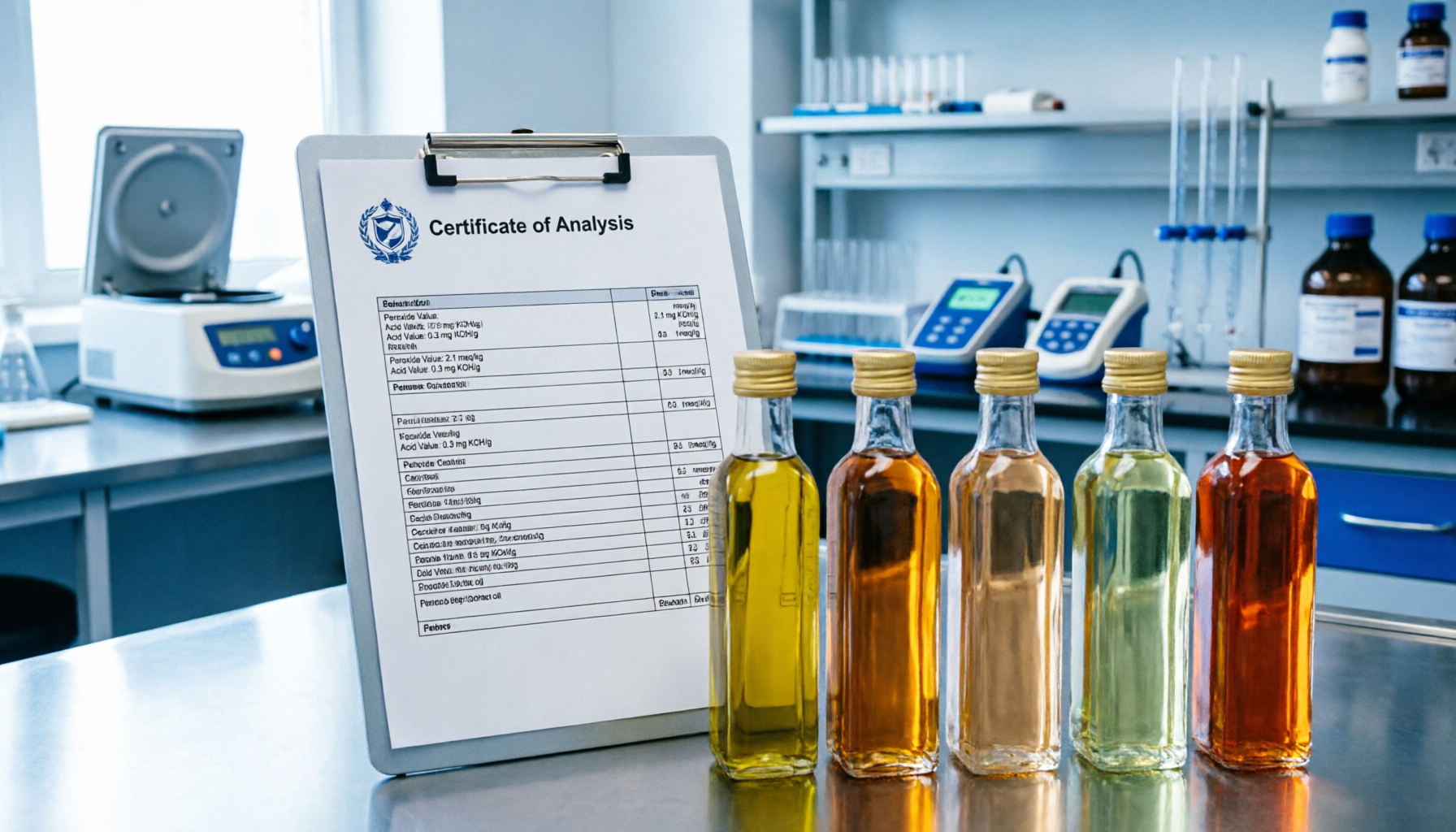
How to Read an Edible Oil COA: The Key Parameters Every Importer Must Check
September 29, 2026
What Is a Certificate of Analysis (COA)?
A Certificate of Analysis (COA) is a document issued by the manufacturer or an independent laboratory that certifies the quality and specifications of a specific batch of product. For edible oil importers, the COA is the single most important quality document you will receive with each shipment. It serves as your primary evidence of product conformity and is often required by customs authorities, food safety regulators, and your own quality assurance team.
However, a COA is only useful if you know how to read it correctly. Many importers — especially those new to the edible oil trade — receive COAs without fully understanding what the parameters mean, what the acceptable ranges are, and which values should raise red flags. This guide breaks down every critical parameter you need to check.
Essential COA Parameters Explained
1. Free Fatty Acid (FFA) / Acid Value
What it measures: The percentage of free fatty acids in the oil, expressed as a percentage of oleic acid (or sometimes as mg KOH/g oil for Acid Value).
Why it matters: FFA indicates the degree of hydrolytic degradation. High FFA means the oil has been exposed to moisture, heat, or poor handling, leading to breakdown of triglycerides. High FFA causes off-flavors, reduced smoke point, and shorter shelf life.
| Oil Type | Acceptable FFA Range | Red Flag |
|---|---|---|
| Refined oils (soybean, sunflower, palm) | ≤ 0.1% | > 0.3% |
| Refined peanut oil | ≤ 0.1% | > 0.2% |
| Extra virgin olive oil | ≤ 0.8% | > 1.0% |
| Cold-pressed oils | 0.5-2.0% | > 3.0% |
| Crude oils (for further refining) | ≤ 5.0% | > 7.0% |
2. Peroxide Value (PV)
What it measures: The amount of peroxides formed during the initial stage of oxidation, expressed in milliequivalents of active oxygen per kilogram (meq/kg).
Why it matters: Peroxide value is the primary indicator of freshness and oxidative stability. High PV means the oil has already started to oxidize, which leads to rancidity, off-flavors, and reduced nutritional value.
| Oil Type | Acceptable PV Range | Red Flag |
|---|---|---|
| Refined oils | ≤ 1.0 meq/kg | > 5.0 meq/kg |
| Virgin / cold-pressed oils | ≤ 5.0 meq/kg | > 10.0 meq/kg |
| Extra virgin olive oil | ≤ 20 meq/kg (Codex) | > 20 meq/kg |
Important note: Peroxide value follows a bell curve — it rises during early oxidation and then falls as peroxides break down into secondary oxidation products. A low PV does not always mean fresh oil; it could also mean the oil is heavily oxidized and past the peroxide stage. Always check PV alongside Anisidine Value.
3. Iodine Value (IV)
What it measures: The grams of iodine absorbed per 100g of oil, indicating the degree of unsaturation (number of double bonds in fatty acids).
Why it matters: Iodine value helps verify the oil type and detect adulteration. Each oil has a characteristic IV range. If the IV falls outside the expected range, it may indicate the oil has been blended with a cheaper oil.
| Oil Type | Expected Iodine Value Range |
|---|---|
| Coconut oil | 7-12 |
| Palm oil | 50-55 |
| Peanut oil | 84-106 |
| Olive oil | 75-94 |
| Sunflower oil (conventional) | 118-144 |
| Soybean oil | 124-139 |
| Corn oil | 103-128 |
| Rapeseed / Canola oil | 97-126 |
4. Saponification Value (SV)
What it measures: The milligrams of KOH required to saponify 1g of oil, indicating the average molecular weight of fatty acids.
Why it matters: SV helps confirm oil identity and detect adulteration with oils of different chain lengths. For example, coconut oil has a high SV (248-265) due to short-chain fatty acids, while most vegetable oils fall in the 180-200 range.
5. Moisture and Volatile Matter
What it measures: The percentage of water and volatile compounds in the oil.
Why it matters: Moisture accelerates hydrolysis, increases FFA, promotes microbial growth, and causes splattering during frying. For refined oils, moisture should be ≤ 0.05%. Any value above 0.1% is a red flag.
6. Color
What it measures: The visual color of the oil, typically measured on the Lovibond scale (Red and Yellow values) using a 5.25-inch cell.
Why it matters: Color indicates the degree of refining and can reveal processing issues. Refined oils should be light in color. Dark or inconsistent color may indicate incomplete bleaching, overheating, or contamination.
7. Insoluble Impurities
What it measures: The percentage of solid particles, dirt, or other insoluble matter in the oil.
Why it matters: Impurities indicate poor filtration or handling. For refined oils, insoluble impurities should be ≤ 0.05%. Higher values suggest inadequate processing or contamination during transport.
Additional Parameters to Check
Fatty Acid Composition (FAC)
A detailed breakdown of individual fatty acids (C16:0, C18:0, C18:1, C18:2, C18:3, etc.) expressed as percentages. This is the most powerful tool for detecting adulteration. Compare the FAC profile against known reference ranges for the specific oil type.
Anisidine Value (AnV)
Measures secondary oxidation products (aldehydes). While PV measures early-stage oxidation, AnV measures later-stage degradation. The Totox Value (2 × PV + AnV) provides a comprehensive oxidation assessment. A Totox value above 26 is generally considered unacceptable for refined oils.
Heavy Metals
Lead (Pb), arsenic (As), cadmium (Cd), and mercury (Hg) should all be below detection limits or within regulatory maximums. EU regulations set strict limits: Pb ≤ 0.1 mg/kg, As ≤ 0.1 mg/kg for edible oils.
Aflatoxins
Particularly important for peanut oil and corn oil. Aflatoxin B1 should be ≤ 2 ppb for EU imports and ≤ 20 ppb for US imports. Total aflatoxins (B1+B2+G1+G2) should also be within limits.
Common Red Flags on a COA
Watch out for these warning signs that may indicate a problematic shipment:
- FFA significantly above specification: Suggests poor storage, old stock, or inadequate refining
- PV near or above the upper limit: Oil may already be oxidizing; shelf life will be shortened
- Iodine value outside the expected range: Possible adulteration with a different oil
- Missing parameters: A complete COA should include all standard parameters. Missing values may indicate the supplier did not actually test the batch
- No batch number or date: A COA without batch traceability is worthless
- Results that are "too perfect": Identical values across multiple batches suggest the COA may be fabricated
- No laboratory identification: The COA should clearly state the testing laboratory name, address, and accreditation
- Missing signature or stamp: An unsigned COA lacks accountability
COA Verification Best Practices
- Always request third-party lab COAs: Prefer SGS, Intertek, Bureau Veritas, or other ISO 17025-accredited laboratories over in-house supplier reports
- Verify the COA matches your shipment: Check batch numbers, production dates, and container/seal numbers
- Compare against your purchase specification: Every parameter on the COA should fall within the ranges specified in your contract
- Conduct your own verification testing: For high-value shipments, take independent samples upon arrival and send them to your own lab
- Keep records: Maintain a COA archive for every shipment. This is essential for traceability, regulatory compliance, and dispute resolution
- Know your destination country requirements: Different countries have different maximum limits for FFA, PV, heavy metals, and aflatoxins
Quick Reference: COA Checklist for Importers
| Parameter | Check |
|---|---|
| Free Fatty Acid (FFA) | Within spec for oil type |
| Peroxide Value (PV) | Low — indicates freshness |
| Iodine Value (IV) | Matches expected range for oil type |
| Saponification Value | Within expected range |
| Moisture & Volatiles | ≤ 0.05% for refined oils |
| Color (Lovibond) | Consistent with refined grade |
| Insoluble Impurities | ≤ 0.05% |
| Fatty Acid Composition | Matches oil type profile |
| Heavy Metals | Below regulatory limits |
| Aflatoxins | Within destination country limits |
| Batch Number & Date | Present and matches shipment |
| Laboratory ID & Accreditation | ISO 17025 accredited lab |
| Signature / Stamp | Present and legible |
Work with a Supplier You Can Trust
At HowFun Oil, every shipment is accompanied by a comprehensive COA from an accredited third-party laboratory. We provide full transparency on all quality parameters, and our team is available to help you interpret results and ensure compliance with your destination country's regulations. Contact us to request a sample COA for any of our edible oil products.
Our Quality Control Standards
ISO 22000 and HACCP certified facility with full COA, SGS testing, and export documentation. Every batch is tested before shipment.
Authentic Extra Virgin Olive Oil
Cold-pressed extra virgin olive oil with verified origin and acidity levels. Available in retail bottles and bulk packaging for international markets.
View Olive Oil Products →Explore Our Products
Browse our full range of bulk edible oils for importers, distributors, and food manufacturers.
Need Custom Packaging or Private Label?
We offer full OEM/ODM services including custom formulation, private label branding, and flexible packaging starting from 6,000 bottles.
Explore Custom Services →See How We Help Our Clients
From restaurant chains to international distributors, discover how our edible oil solutions drive business growth for partners worldwide.
View Case Studies →Get a Quote
Fill out the form below and we'll get back to you within 24 hours